Muktibani Online Report
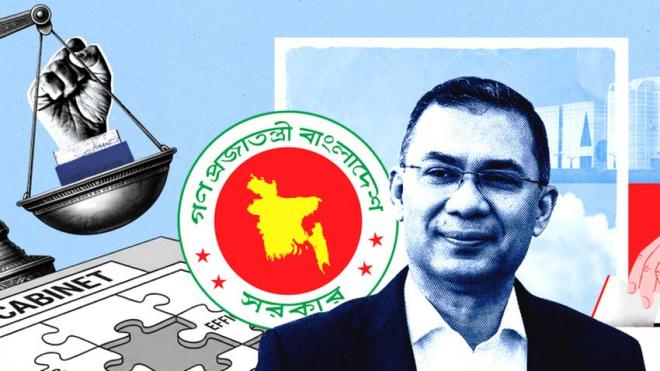 Analysts say some colleagues’ actions undermining PM’s people-centric approach
The BNP government’s strides in sectors like social welfare have not been matched in law and order or energy, analysts say.
Prime Minister Tarique Rahman has sought to project a restrained people-oriented image by cutting protocol, reducing state expenditure, and giving up some privileges traditionally associated with those in power. Analysts said such symbolic changes needed to be matched by progress in all sectors in light of the BNP’s election commitments.
As the government completed its first 180 days in office yesterday, it highlighted the Family Card, Farmer Card and canal re-excavation programmes, record food grain stock as major achievements. It also said it has taken significant steps to restore democracy, ensure good governance, and fulfil its election pledges.
“There appears to be a lack of alignment and coordination between the prime minister’s vision and objectives and those entrusted with carrying them out.” Mohammad Mojibur Rahman Professor at Dhaka University’s Institute of Education and Research
The government touted its waiver of agricultural loans for small farmers, introduction of food assistance at Tk 15 per kg, easy-term loans for women entrepreneurs and young people, and startup fund.
Despite these initiatives, analysts said the government still had a long way to go to make people feel secure in terms of law and order and energy. The ongoing energy crisis has disrupted production and caused hardship for consumers, while law and order remains a major concern, they said.
They said that the BNP’s 31-point reform agenda included a media commission to ensure press freedom and reform the media sector. Six months into the government’s tenure, however, the commission has yet to be formed.
The party manifesto also promised a Truth and Healing Commission to address past human rights abuses, an Administrative Reform Commission to restructure the bureaucracy, a Judicial Commission to reform the justice system, and an Education Reform Commission to overhaul the curriculum and education sector. None of these have been done.
The BNP had also promised an independent inquiry commission to investigate officials accused of state-sponsored terror during the July uprising and probe allegations of vote-rigging and corruption. That commitment, too, has yet to see visible progress.
The analysts also said some of the prime minister’s efforts to project a people-centric government were being undermined by the conduct of party colleagues.
Mohammad Mojibur Rahman, a professor at Dhaka University’s Institute of Education and Research, said the government’s first six months exposed weaknesses in appointments, planning, and coordination.
“It is not possible for the prime minister to do everything alone, which is why he has assigned different responsibilities to different people. But there appears to be a lack of alignment and coordination between the prime minister’s vision and objectives and those entrusted with carrying them out.”
During this period, BNP-affiliated persons have been appointed to top posts at 11 government institutions on a contractual basis, while party figures have been appointed administrators of 11 city corporations and 42 district councils. Almost all the appointed vice-chancellors are current or former leaders of pro-BNP teachers’ organisations.
Analysts said such appointments ran counter to the BNP’s electoral manifesto pledge of merit-based recruitment to government positions.
While unveiling the BNP’s election manifesto on February 6, Tarique identified curbing corruption as one of his government’s main priorities.
Yet, the perception of corruption in the government among people is rife. On July 30, a senior BNP leader publicly admitted that bribes in government offices are going on unabated.
Analysts pointed to a contrast between Tarique’s conduct and that of some of his colleagues.
According to party leaders, Tarique rejected a proposal to name an institution after his mother, former prime minister and BNP chairperson Khaleda Zia. However, a state minister proposed naming two unions in his constituency after family members. The names were changed after criticism and the prime minister’s intervention.
Al Masud Hasanuzzaman, a former professor of government and politics at Jahangirnagar University, said the government’s image could suffer if it fails to rein in ministers and state ministers over controversial statements and actions.
Analysts say law and order has improved a bit compared to the interim government’s tenure. But there is a lot of scope for improvement. There has been hardly any let-up in murders, extortion incidents, mob attacks, kidnappings and other crimes across the country, renewing public anxiety over safety.
Although the authorities carried out several anti-crime drives over the last three months, the situation remains volatile.
Prof Mojibur said the government should have prioritised public safety over other matters such as multiple welfare initiatives.
“Law and order should have come first. The situation remains fragile,” he said.
WHAT PEOPLE SAY
Media spoke to 31 people in eight districts -- Pirojpur, Netrokona, Pabna, Cox’s Bazar, Kushtia, Sirajganj, Jamalpur and Dhaka. Of them, 18 gave broadly negative assessments, mainly citing rising prices, stagnant or falling incomes, sluggish business, electricity and gas shortages, higher farm costs and concerns over law and order.
Another 12 gave mixed or neutral views, saying six months was too short to judge the government or acknowledging some improvements. One respondent gave a clearly positive assessment.
[Our respective district correspondents also contributed to this report.]