
For years I dreamed of silence. Between a home with three young children and a pediatric clinic crowded with restless kids, the noise at times felt relentless. A family and a meaningful career were all I ever wanted, but sometimes I yearned for quiet. Just a moment of peace.
I don’t wish for that anymore.
In Rachel Carson’sSilent Spring, the revolutionary book that sparked the modern environmental movement, the birds that no longer sang weren’t the tragedy. They were the signal. A warning that something essential was dying. I hear a similar warning now in a different kind of silence: the eerie, algorithm‑induced quiet of children transfixed by technology.
We are social creatures. We chat and complain, debate and tell stories. We embrace, bump fists, communicate nuanced emotions wordlessly—an eye roll, a smile, a shrug. We call out to each other in stadium crowds, console crying babies on airplanes. This is what we do. And these lively, sometimes irritating, often messy, but always essential noises are the product of our species connecting and caring for one another.
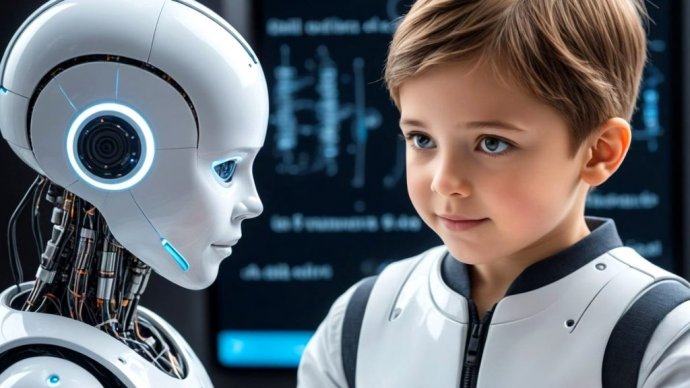
The volume of this beautiful, chaotic music is slowly being turned down. Technologies that once lived squarely in the realm of science fiction are now entering nurseries, classrooms, and family life at extraordinary speed, capturing the attention of adults and children alike. Companies are developing versions of popular AI chatbots specifically for kids.Entertaining AI dolls and action figures are core to the strategic vision of major toy brands. Virtual AI tutors are being promoted as the future of education around the world.
AI has also moved into our lives in subtler ways. When you scroll social media or look for your next watch on Netflix, intelligent algorithms select or suggest the content for you. These AI‑powered recommendation engines are designed to predict what will hold your attention and keep you glued to the screen. If your little ones are watching YouTube, they too are under the sway of the technology as it works silently in the background to hold them close and shape their experience. The very content they consume might have been created by AI, including a flood of supposedly educational AI‑generated videos. These low‑quality, error‑filled abominations known as AI slop don’t just fail to teach. They actively misinform. They embed misspellings, peddle nonsense, and model unsafe behaviors for children too young to know the difference. And the companies developing these technologies are racing ahead of the rules as they’re being written.
Policymakers are struggling to understand what they are regulating. The rest of us are struggling to understand how our world is changing. Perhaps one day these gaps will close, but childhood will not wait.
I believe that the relationship between child development and artificial intelligence is one of the most critical and overlooked challenges of our time, one that has the potential to transform childhood, family structures, and ultimately nothing less than our future as a species. And it’s up to us as parents and caregivers to decide how these intelligent tools will shape our children’s lives. Not companies. Not governments. We are the ones who will take the lead on deciding what these technologies replace, what they enhance, and what they should never touch. And we are uniquely equipped to do so, as we possess something critical that machines are missing.
Nobel laureate Geoffrey Hinton , known as the Godfather of Artificial Intelligence for the pivotal role he played in creating the AI systems now remaking our world, left Google in 2023 to warn humanity about what he’d helped build. He spoke of existential risks, of systems that might one day surpass us. But when asked once what we might do to make artificial intelligence safe, he gave a surprising answer.
He suggested we embed maternal instincts in these systems.
Not better algorithms. Not more guardrails. Not elaborate structures of rules and constraints. Maternal instincts. The primal, inexplicable forces that make any parent—mothers and fathers—go to the ends of the earth to protect and care for their child without calculating the expected return.
I have spent years studying the evolutionary origins of these parental instincts and their profound importance in building children’s brains. Human babies are born powerless, weak, and extremely needy. Yet these tiny, vulnerable creatures somehow commandeer the lives of adults many times their size and strength. I call this the helpless infant paradox. There is no other example I can think of in nature of such complete power held by such powerless entities. Yet this is the very source of our success as a species. The instinct to nurture is wired so deeply into parents that it feels less like a choice than a biological imperative.
These past few decades, I’ve watched our culture focus on trying to make humans more like machines. More efficient, more optimized, more productive. We have quantified and data‑fied childhood, turned parenting into a performance metric, measured our worth in developmental milestones met and cognitive outputs achieved. And now one of the scientists at the very frontier of machine intelligence is asking the opposite question: How do we make machines more like humans?
The biggest missing piece in all of artificial intelligence, roboticist Matthias Scheutz told me, is that “none of our machines care.”
But can we fix that? Is Hinton’s hope even possible? Can we code parental instinct? Can we engineer caring?
When I posed these questions to Scheutz, a philosopher turned roboticist who has spent decades thinking about human and machine minds, his answer cut to the heart of what separates us from even the most sophisticated AI. He pointed me to a philosophical concept: original intentionality. Our thoughts, he explained, don’t just process information—they reach toward what matters to us. Our cognition isn’t mere information processing. It’s grounded in something deeper. A scientist who devotes their life to understanding children’s brain development is driven by passion and concern.
Parental instincts, Scheutz mused, are subconscious, visceral. Love coming from biological intentionality. The product of millions of years of evolution rather than countless lines of code, refined by the brutal simplicity of survival. In short, children needed loving caregivers to live. The survivors then raised their own children with the same fierce attention. And so it continued, an unbroken chain of caring, until it reached you.
You have the quality the machines are missing. The love no code can copy.
What makes us human? Is it reason? Language? Creativity? Tool use? Artificial intelligence is eroding our supposed superiority in each area one by one. It produces outputs indistinguishable from reasoning. It generates language with fluency that surpasses most humans. AI turns out art, music, poetry, software. It uses existing tools and builds new ones.
But AI does not care.
No algorithm lies awake at night worrying about whether a struggling child finally learned to read. No chatbot feels the weight of unrealized human potential. No system, however sophisticated, has thoughts that are genuinely about your child, that one‑of‑a‑kind combination of genes and experiences. These technologies act on patterns shaped by everyone else’s data, targeted at producing responses that look like caring.
True caring—our capacity to have heartfelt thoughts about another being, rooted in concern for their flourishing, irrational in their intensity—is what makes us unique. It is the irreducible human core.
Excerpted fromHUMAN RAISED: Nurturing Connection, Curiosity, & Lifelong Learning in the Age of AIwith permission from Dutton, an imprint of Penguin Random House.