For generations, people living in Bangladesh’s tea gardens have carried a single label: “tea worker”. Behind that label, however, lies a quieter crisis — the erosion of distinct languages, cultures and identities, many now at risk of disappearing.
Although International Indigenous Peoples’ Day has been observed across the country for the past 32 years, many tea garden workers remain unaware of its significance. Trapped in cycles of poverty and labour, few have the time or means to reflect on their ethnic identities.
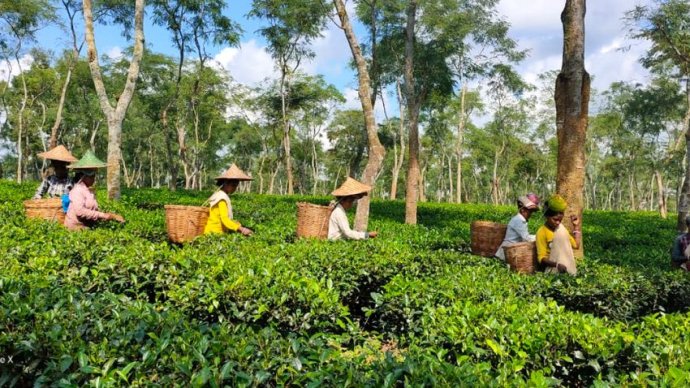
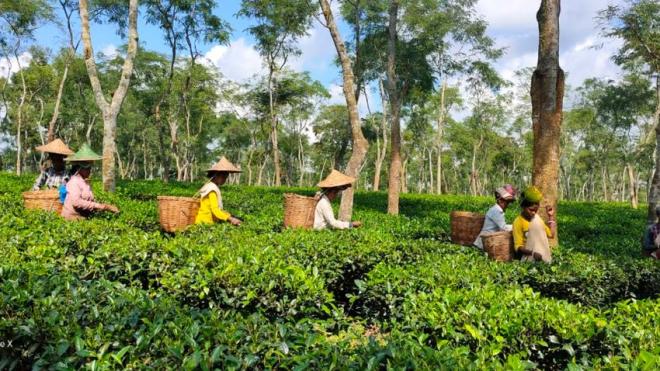
A visit to tea gardens in Sreemangal in Moulvibazar and Chanpur in Habiganj found workers picking tea leaves under scorching sun and heavy rain. Many said they had never heard of the day.
“We have forgotten our own ethnicity amid poverty and hardship,” said Goura Lohar, a worker at Chanpur tea garden. “What is a day again? All days are the same for us.”
Their struggle is not only economic.
Kasailla Ghatual, 47, who has worked at Harinchara tea garden in Sreemangal since she was 14, recalled earning a daily wage of just Tk 20 when she started. Her wage now stands at Tk 187, still not enough to meet her family’s basic needs.
“I cannot eat two proper meals a day with my family,” she said. “I dream of having a home of my own, but how is that possible on this income?”
Asked about Indigenous Peoples’ Day, she said, “There are processions on the streets. That’s all I know.”
Nipen Paul, general secretary of the Bangladesh Tea Workers Union, said generations of labour in the industry had not translated into land ownership or improved living standards.
“The tea industry has progressed, but workers’ lives have changed very little,” he said.
Liton Ganju of Patrakala tea garden said many lesser-known indigenous communities live in the tea gardens, with their languages and cultures at risk of disappearing because they lack the recognition given to communities such as the Manipuri, Khasia or Garo.
“There is a fine arts academy for the Manipuri community to preserve their culture,” he said. “But there is no such institution for the 30 to 35 indigenous communities of the tea gardens.”
Dilip Ranjan Kurmi, president of the Sylhet Tea Community Students Youth Welfare Council, said “tea worker” was a professional identity, not an ethnic one.
He put the total population living in Bangladesh’s tea gardens at around 10 lakh.
“Just as tea plants are not allowed to grow beyond a certain height, the lives of tea workers, too, are kept confined. We see the greenery of the gardens, but not the tears of the workers,” he said.
Samar M Soren, a language activist and head of the Language Resource Hub, said the crisis extended beyond poverty to language, culture, identity and human rights.
With no access to mother-tongue education, he said, younger generations are rapidly losing native languages such as Santali, Kurukh and Mundari in favour of “Bagani Bhasha” or Sadri. Folk songs, oral traditions, traditional medicine and generations of accumulated knowledge are being lost with them.
“Losing a language is not just about losing words. It means losing an entire community’s way of seeing the world, its history and knowledge systems,” he said.
Gauranga Patro, president of the Sylhet division of the Bangladesh Indigenous Forum, called for all indigenous communities living in tea gardens to be included in the state’s official indigenous list, along with greater awareness of their constitutional rights and concrete steps to preserve their languages and traditions.